


The evaluation was ordered. It was framed as standard procedure. The organization was following its accommodation obligations, making sure your workstation and job functions were appropriate given your restrictions.
You believed it. Why would you not. The language was supportive. The process appeared compliant. The people involved seemed to be acting in good faith.
By the time the evaluation was complete, a documented record existed that your current role, as structured, was not compatible with your medical restrictions. That record was not created to help you. It was created to support what came next.
Leave. Restructuring. Separation. All of it defensible because the documentation existed. All of it preceded by a process that looked like support.
HOW THE ACCOMMODATION PROCESS BECOMES A DOCUMENTATION STRATEGY
The Americans with Disabilities Act and similar state laws require employers to engage in what is called the interactive process when an employee requests an accommodation. That process is legitimate. It is also a documentation process.
Every step of the interactive process is documented. The request. The employer’s response. The evaluation. The proposed accommodation. The employee’s acceptance or rejection. The outcome.
In organizations where the decision to move against an employee has already been made, the interactive process is sometimes used to build a record that makes that decision defensible. The accommodation is offered or evaluated in a way that is designed to produce documentation of incompatibility rather than documentation of support.
The key indicators are in the framing. A genuine accommodation process identifies what modifications would allow the employee to perform the essential functions of the role. A documentation strategy identifies why the essential functions cannot be performed given the restrictions.
Those are not the same inquiry. The difference in framing tells you which process you are inside.
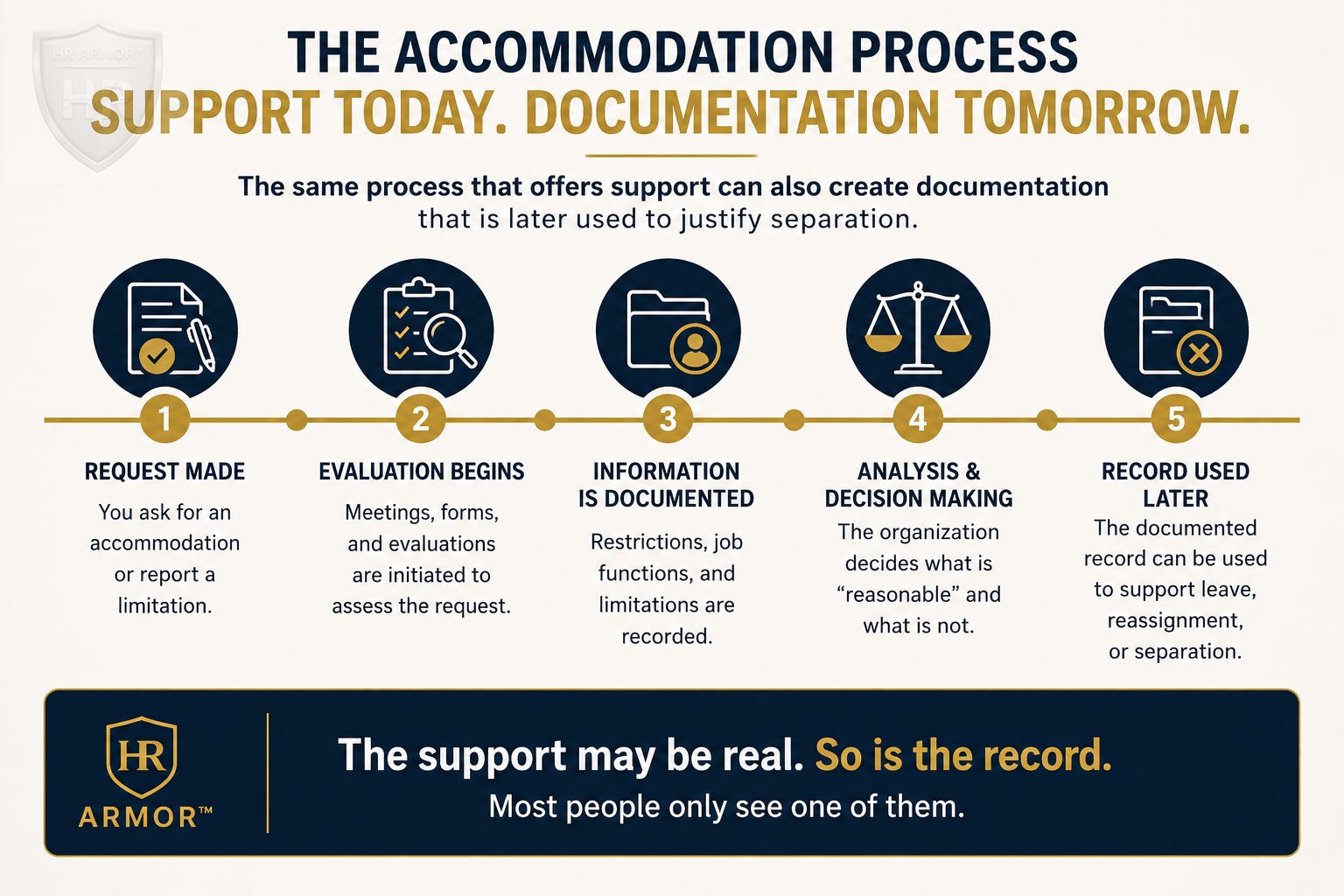
THE HR ARMOR DOCUMENTATION PHASE
What clients describe as an accommodation gone wrong almost always follows the same sequence. This is what HR Armor identifies as the Documentation Phase: a period during which the organization is building the record that will support a predetermined outcome while maintaining the appearance of process compliance.
In the accommodation context, the Documentation Phase looks like this. The evaluation focuses on what cannot be done rather than what can be modified. The proposed accommodations are structured in ways the employee is likely to reject or that create new documentation. The interactive process correspondence is carefully worded to show the employer engaged in good faith while the employee’s restrictions made accommodation impossible.
By the end of the Documentation Phase, the employer has a file that shows they tried. What the file does not show is what the intent behind the process was.
Most employees focus on getting the accommodation approved. Few realize the documentation created during that process may become more important than the approval itself.
WHAT THE SUPPORT LANGUAGE CONCEALS
The most disorienting element of this pattern is that the support language is often genuine. The HR professional conducting the evaluation may believe they are helping. The manager may genuinely want to find a solution. The process can be run in good faith at the individual level while being used strategically at the organizational level.
This is why the intent of the individuals involved is not the right question. The right question is what the documentation produced by the process shows and how it can be used.
A documented record that your restrictions are incompatible with your essential job functions is a document. It exists regardless of whether the person who created it intended it as a weapon. And once it exists, the organization has the option to use it.
The offer of support and the building of the exit record can happen at the same time. Most people only see one of them until it is too late to build against the other.
WHAT TO WATCH FOR IN REAL TIME
The signals that an accommodation process is functioning as a documentation strategy are visible if you know what to look for.
The evaluation focuses on limitations rather than modifications. Instead of asking what changes would allow you to perform your duties, the evaluator documents in detail why your current restrictions prevent you from performing them.
The proposed accommodations are presented as options you must accept or reject in writing. Each rejection creates a record that the employer offered accommodation and you declined. Each acceptance may create a record that you agreed the modified role is the full extent of what is available.
The timeline accelerates after the evaluation. Decisions about leave, role restructuring, or separation that had not previously been discussed suddenly appear as options being considered. The evaluation produced the justification. The decisions follow from it.
The language of concern intensifies. People who were previously neutral begin expressing worry about your wellbeing, your ability to manage the demands of the role, your long-term health. That language, in writing, builds a record that the organization prioritized your welfare in whatever came next.
WHAT TO DO WHILE THE PROCESS IS ACTIVE
If you are inside an accommodation process right now, the documentation you create or fail to create during this period matters.
Document every communication. Every meeting, every email, every proposed accommodation, every response. Your record of the process needs to exist alongside the employer’s record of the process.
Pay attention to the framing of every question asked in the evaluation. If questions are oriented toward what you cannot do rather than what modifications would help you do it, flag that in your own documentation.
Do not sign acknowledgment forms or acceptance documents without understanding exactly what they document. A signature that appears to confirm your restrictions are incompatible with essential functions is a significant piece of documentation that exists in the employer’s file.
Identify whether the timeline of the accommodation process aligns with other events in your employment. A request for accommodation that triggers an evaluation, a finding of incompatibility, and a discussion of leave or separation within a compressed period is a sequence, not a coincidence.
The accommodation process can protect you. It can also be used to build the case against you. Knowing which one you are inside while the process is still active is the difference between protecting your record and watching it get used against you.
If you are inside an accommodation process and something about it does not feel like support, trust that read.
Noël HR Armor | Strategic Case Architect
You file. I architect.
This communication is for strategic planning purposes only and does not constitute legal advice. All engagements handled in strict confidence.