

The supervisor scheduled a Friday meeting marked urgent. The employee was out of town. The supervisor was not there when the meeting was supposed to happen.
On the surface this looks like poor planning. A miscommunication. A scheduling error that happens in busy organizations.
It is not.
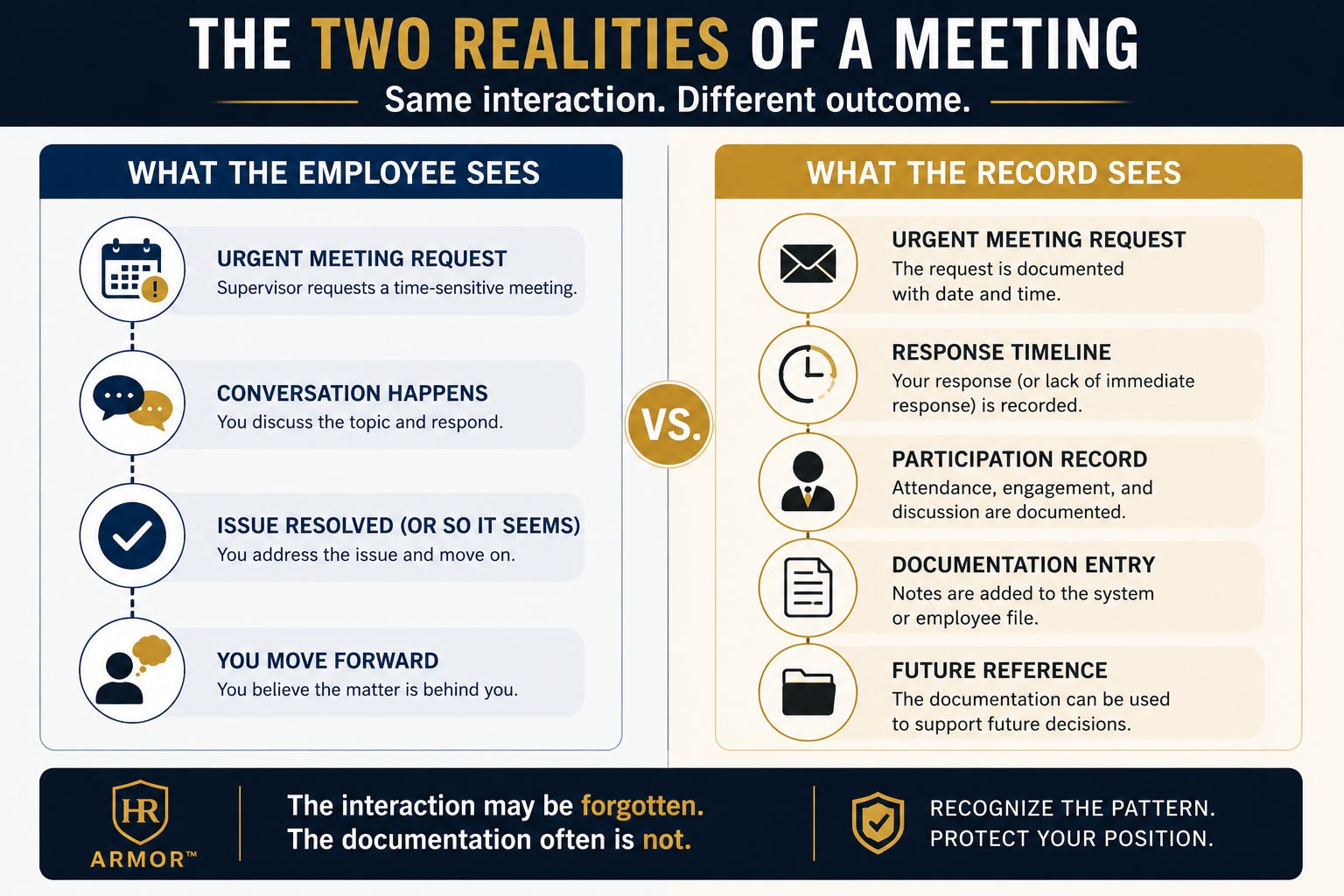
The urgency of the scheduling request created a record that a time-sensitive matter required immediate attention. The employee’s unavailability created a record that the employee did not respond. The supervisor’s absence removed any possibility of the meeting resolving the documented concern. The paper trail was the entire point. The meeting never needed to happen.
THE ESCALATION PATTERN
HR Armor identifies this as the Escalation Pattern: a sequence of workplace interactions designed to produce documentation of employee unavailability, unresponsiveness, or non-compliance with management direction, without requiring the employer to take a formal disciplinary step.
The Escalation Pattern operates by creating situations where the employee’s normal behavior - being out of town, not checking email after hours, responding to a request within a reasonable timeframe - is framed through documentation as a performance or conduct concern.
The pattern is difficult to recognize in real time because each individual element looks ordinary. An urgent meeting request is normal. A scheduling conflict is normal. A supervisor running behind is normal. The sequence, documented together, is not normal. It is manufactured.
HOW DOCUMENTATION GETS MANUFACTURED THROUGH ORDINARY INTERACTIONS
The check-in that is framed as a progress conversation but documented as evidence of continued performance concerns. The email that requires a response by end of business on a day the employee is known to be offline. The task assigned at the end of a workday with a same-day deadline. The request for documentation of work product that has never previously required documentation.
None of these interactions, in isolation, is unusual. Taken together in a compressed timeline following a protected activity or a performance management initiation, they form a documented sequence that the employer can present as a pattern of performance or conduct issues.
What makes this pattern particularly effective from the employer’s perspective is that the employee often participates in building it. The response to the urgent email that arrives at 9pm - even if it says the employee is unavailable - creates a record that the employee was aware of the urgency and responded at a delayed time. The explanation for the missed deadline (even a legitimate one) creates a record that a deadline was missed and an explanation was offered.
The employee is not doing anything wrong. The documentation of the interaction is what matters, not the conduct itself.
Workplace outcomes are rarely decided by a single meeting.
They are built through a series of documented interactions that look harmless on their own.
WHAT THE CHECK-IN IS ACTUALLY DOCUMENTING
One of the most consistent examples of this pattern is the PIP check-in framed as a progress conversation. Every PIP includes regular check-in meetings. Every check-in is presented as an opportunity to discuss progress, address concerns, and demonstrate improvement.
What the check-in actually does is document. Every word said in that room gets recorded against the criteria in the PIP. The employee who explains a challenge is documenting a performance gap. The employee who asks for clarification is documenting that the expectations were unclear to them. The employee who agrees with feedback is documenting agreement with a characterization they may later want to dispute.
The check-in is not about progress. It is about the file. And by the time most employees understand that, several check-ins have already been documented.
The interaction was the point. What it put into the record was the goal. Most employees ask why the interaction happened. The right question is what the record now shows because it did.
RECOGNIZING THE MOVE IN REAL TIME
The signals that an interaction is functioning as a documentation strategy rather than a genuine workplace communication are recognizable once you know what to look for.
The timing is compressed or unusual. The request arrives outside normal business hours, on a day the employee is known to be unavailable, or immediately following a protected activity or a formal process initiation.
The format shifts. A conversation that previously happened verbally is now requested in writing. A task that previously had flexible timelines now has a specific deadline. A relationship that previously operated informally now operates through official channels.
The witnesses change. People who were not previously part of interactions are now present. Emails are copied to people who were not previously included. Meetings that were one-on-one now include HR or additional management.
The subject matter shifts from performance to conduct or character. Questions about work product give way to questions about responsiveness, attitude, or professionalism. This shift signals a move from the Performance Documentation Phase to the Narrative Phase, where the characterization of the employee rather than their output becomes the focus.
Most employees remember the conversation.
The organization remembers the record.
Those are rarely the same thing.
WHAT TO DO WHEN YOU RECOGNIZE THE PATTERN
The most important thing to do when you recognize the Escalation Pattern is to start your own documentation immediately. Not because the employer is necessarily acting in bad faith, but because the record being built in real time is not the only record that can exist.
Document the interactions. The date, the nature of the request, the format, the timeline, who was present or copied, and what the stated purpose was. If the stated purpose and the documented outcome are different, that gap is significant.
Respond to every interaction in writing where possible. Not because you are being difficult, but because a written response creates your record of what happened alongside the employer’s record.
Pay attention to the sequence. Individual interactions look ordinary. The sequence, documented together, tells a different story. Your timeline of the sequence is evidence that the pattern exists.
The meeting was never about the meeting. Now you know what to do with that.
If interactions at work are starting to feel like they are about something other than what they claim to be about, that read is worth paying attention to.
Noël HR Armor | Strategic Case Architect
You file. I architect.
This communication is for strategic planning purposes only and does not constitute legal advice. All engagements handled in strict confidence.