

Some workplace interactions are not about what they appear to be about. The interaction is the point. The record it creates is the goal. Here is how to recognize manufactured documentation inside ordinary workplace moments.
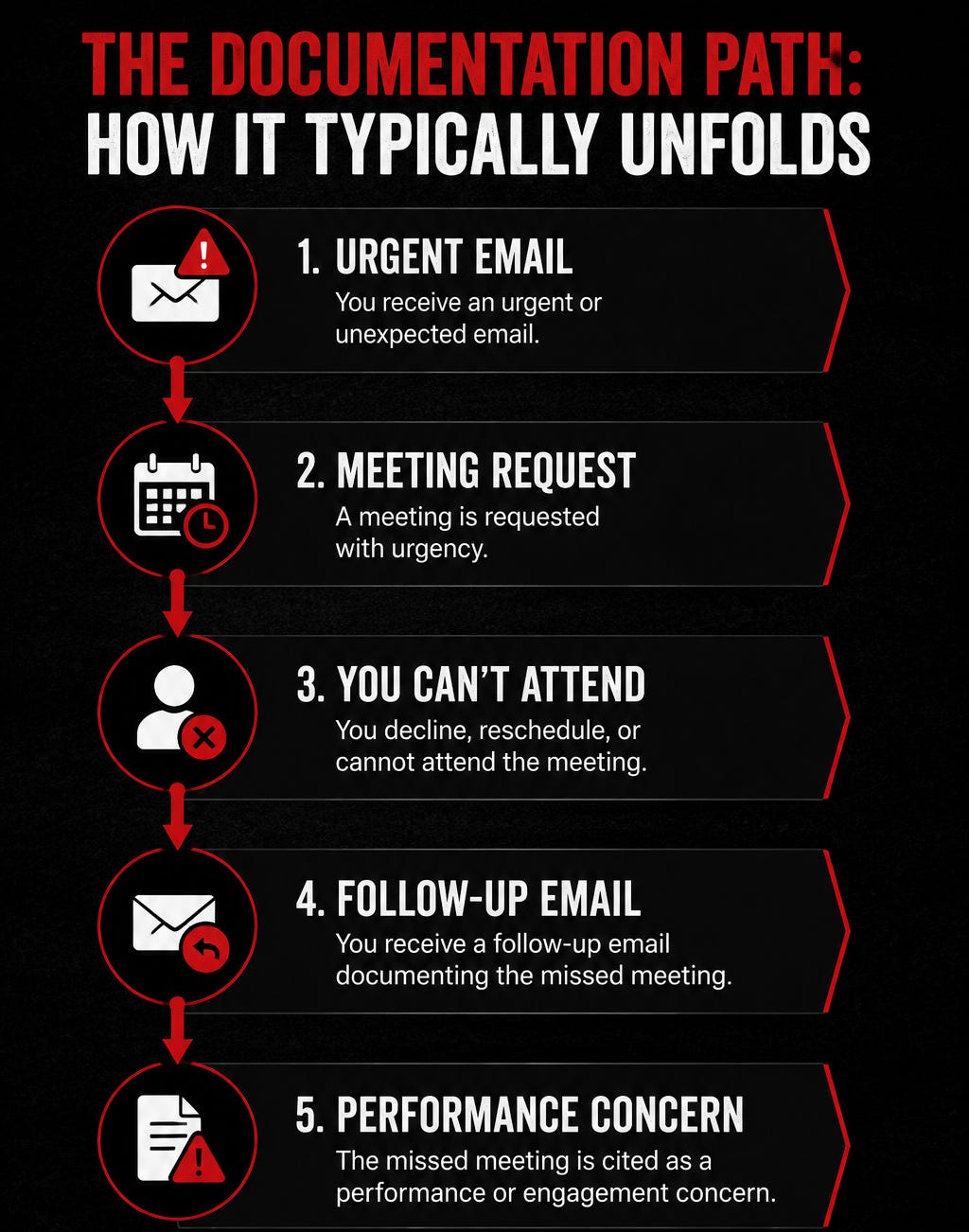
The meeting request arrived marked urgent. A time had already been chosen. The subject line was vague. The meeting needed to happen soon.
You were unavailable. You noted the conflict and indicated you could not attend at the time selected. The meeting time passed. The supervisor was not there either.
On the surface this looks like a scheduling failure. A miscommunication in a busy organization. The kind of thing that happens and gets forgotten.
What it actually created was a documented sequence. The urgency of the request created a record that a time-sensitive matter required immediate attention. Your unavailability created a record that you did not respond to a time-sensitive matter. The supervisor’s absence ensured the meeting could not resolve the documented concern and left the record unresolved.
The meeting never needed to happen. The documentation of the attempt did. And the documentation exists whether or not anyone ever acknowledged what it was for.
HOW MANUFACTURED DOCUMENTATION WORKS
Manufactured documentation is the creation of a paper trail through ordinary workplace interactions that are designed or timed to produce a record of employee conduct, availability, or responsiveness. The interactions themselves are not unusual. Urgent meeting requests happen. Scheduling conflicts happen. Supervisors run late or miss calls.
What makes an interaction manufactured documentation is the purpose behind it. When an urgent meeting request is sent to an employee who is known to be unavailable, and no genuine effort is made to reschedule, and no resolution is needed or expected, the purpose of the request was the request itself. The documentation it created was the outcome the interaction was designed to produce.
This is the Escalation Pattern: a sequence of ordinary workplace interactions that together produce a documented record of performance or conduct concerns without requiring the employer to take a formal disciplinary step. Each individual element looks routine. The sequence, in context, is not.
WHAT GETS DOCUMENTED THROUGH ORDINARY INTERACTIONS
The urgent email sent at 6pm on a Friday that requires a response by end of day. The task assigned with a same-day deadline on a day the employee is known to have external commitments. The meeting request for a day the employee had already communicated as unavailable. The follow-up email documenting that no response was received.
Each of these interactions produces documentation. The documentation does not say the employee did something wrong. It says the employee was unavailable, did not respond in time, or did not attend a meeting. That documentation, accumulated over a period of weeks or months, creates a pattern the employer can characterize as performance or conduct concerns.
The employee who responds defensively to each interaction adds to the documentation. The employee who explains their unavailability creates a record of the explanation. The employee who escalates or pushes back creates a record of the escalation. Every response is documentation and the employer controls the framing of the record.
THE CHECK-IN AS DOCUMENTATION EVENT
The most consistent example of this pattern is the PIP check-in. Every check-in is presented as a progress conversation. Every check-in is a documentation event.
What the employee says in the check-in meeting goes into the record. Agreement with feedback documents agreement. Pushback documents resistance. Questions about the criteria document uncertainty about expectations. Silence documents that concerns were raised and not disputed.
The check-in is designed to produce documentation regardless of how the employee participates. The employer controls the meeting, controls the framing, and controls what gets written down after it. The employee participates in a process whose output they never see until it is used against them.
The meeting never needed to happen. The documentation of the attempt did. Recognizing the difference is what changes your position.
RECOGNIZING THE MOVE IN REAL TIME
The signals that an ordinary interaction is functioning as a documentation strategy are visible once you know what to look for.
The timing is unusual. The request arrives when you are unavailable, outside normal hours, or immediately following a protected activity or formal process. The format is more formal than the relationship has previously required. A conversation that previously happened verbally is now requested in writing. A task that previously had flexible timelines now has a specific deadline.
The follow-up documents what did not happen. After the meeting did not occur, an email is sent noting that the meeting was missed or the matter remains unresolved. The documentation of the unresolved concern is the outcome that was needed.
The subject matter does not require urgency. The situation described as time-sensitive is not materially different from situations that were previously handled without urgency.
The urgency is the framing, not the reality.
WHAT TO DO WHEN YOU RECOGNIZE IT
Document the interaction before you respond to it. The date, the nature of the request, the format, the timing, who sent it, and what the stated urgency was. Your record of the interaction exists alongside the employer’s record.
Respond in writing where possible. A written response creates your version of the record. If you are unavailable, a written response stating your unavailability and proposing an alternative is documentation that you did respond, you were not unresponsive, and you attempted to engage with the matter.
Do not over-explain in your response. An explanation that goes beyond acknowledging the conflict and proposing an alternative creates material that can be used in ways you cannot control.
Document the sequence. One unusual interaction may be coincidence. A sequence of unusual interactions following a triggering event is a pattern. Your documentation of the sequence is evidence that the pattern exists.
The meeting request was the move. Now you know how to document the move alongside the employer’s documentation of it.
If workplace interactions have been feeling off and you cannot name why, The Record shows you what to look for.
The interaction wasn’t the objective.
The record was.
AT HR ARMOR
The Record is now available for pre-order.
The Record is the employee-side playbook for PIPs, investigations, documentation traps, retaliation patterns, and the moves employers make before termination. If the Escalation Pattern sounds familiar, The Record is where you start.
Inside a live situation right now? Book a Rapid Strategy Session:
Noël HR Armor | Strategic Case Architect
You file. I architect.
This communication is for strategic planning purposes only and does not constitute legal advice. All engagements handled in strict confidence.