

When an employer uses your health as the justification for removing your responsibilities, the framing is designed to make the change unchallengeable. Here is how to recognize the move before you accept it.
The supervisor expressed concern. Your workload was too heavy. The role was demanding. Leadership was worried about the stress you were carrying.
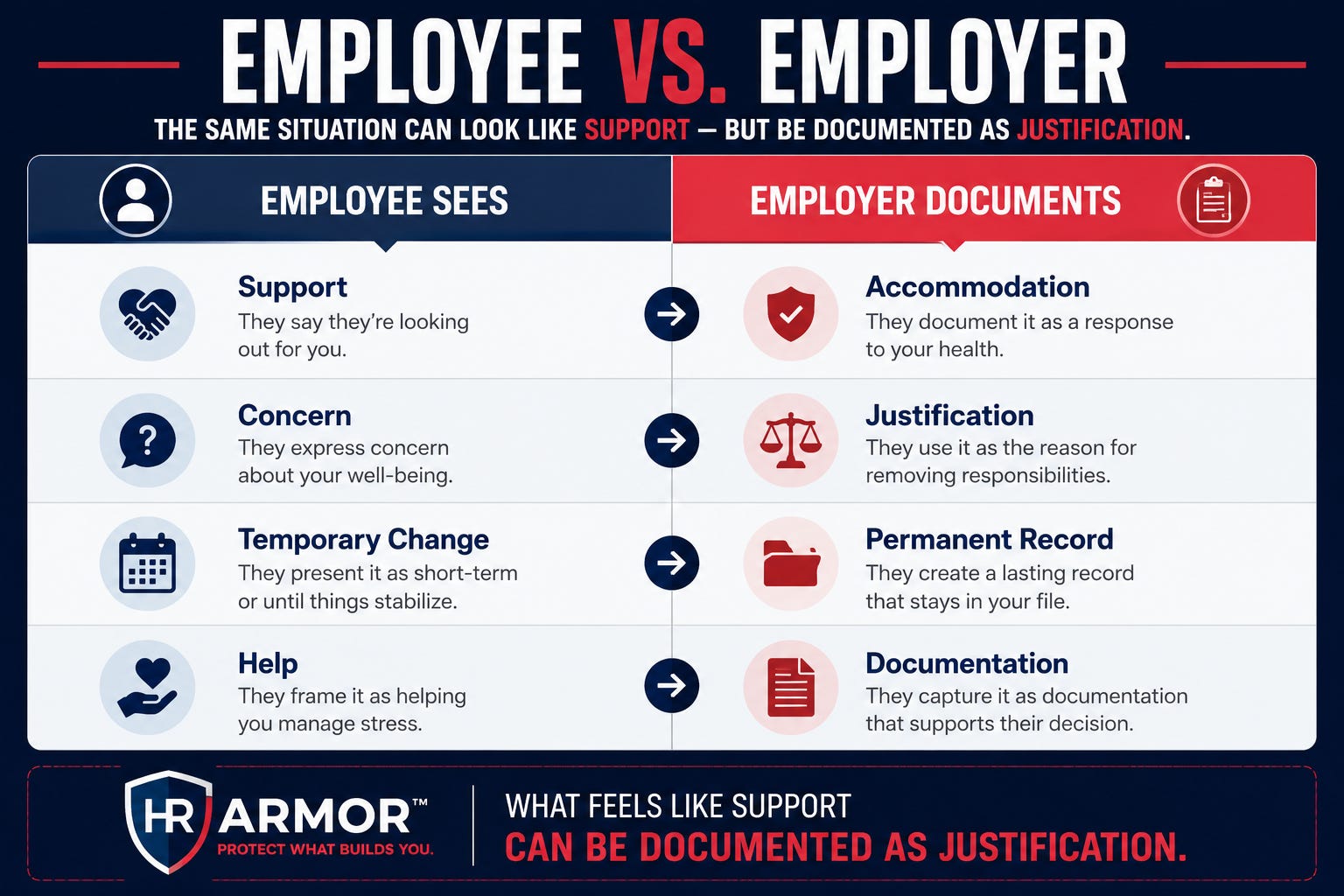
Would you be willing to hand off some of your key responsibilities? Just temporarily. Just until things stabilized. Just because they cared about you.
The offer felt like support. It arrived in the language of care. There was no performance critique attached to it, no formal process, no documentation of a problem. Just a manager saying they were looking out for you.
What was actually being offered was a demotion with a medical justification already built into the record. If you had accepted, the documentation would show that the role change happened because of your health, at your employer’s supportive suggestion, and with your agreement.
No retaliation claim available. No wrongful demotion argument. A voluntary role change that stripped what you had, supported by a paper trail that showed the employer was acting out of concern.
HOW CONCERN BECOMES DOCUMENTATION
The framing of concern is one of the most effective documentation strategies in workplace management because it removes the adversarial appearance from a harmful act. A termination looks like retaliation when it follows a protected activity. A role change framed as support for your health looks like accommodation.
The distinction matters because it determines what legal framework applies to what happened to you. A demotion is an adverse employment action that can support a retaliation or discrimination claim. A voluntary role change accepted by the employee at the employer’s supportive suggestion is significantly harder to challenge.
The employer does not need to say the role change is punitive. The employer needs the documentation to show the role change was supportive. Your acceptance of the offer is the documentation they need.
THE TWO THINGS HAPPENING AT THE SAME TIME
When an employer uses health as the justification for removing responsibilities, two things are happening simultaneously. The employer is creating a documented reason for the role change that is not retaliatory or discriminatory on its face. And the employer is testing whether the employee will accept the framing.
An employee who accepts the framing participates in building the record that the change was appropriate. An employee who accepts the role change itself has agreed to a diminished position and waived the opportunity to challenge it as a demotion.
The acceptance does not need to be explicit. Continuing in the modified role without documented objection is itself documentation that the role change was accepted.
This is why the moment of the offer is the critical window. Before the acceptance. Before the continued participation. Before the record hardens around the framing of concern.
WHAT TO LOOK FOR BEFORE YOU RESPOND
The signals that a concern-framed offer is actually a documentation strategy are identifiable if you know what to look for.
The responsibilities being removed are significant. Not administrative tasks or incidental duties, but core functions of your role. Functions that define your title, your standing, your compensation basis, or your access.
The timing connects to a prior event. The concern appeared after a protected activity, a medical leave, an accommodation request, a complaint, or a change in the relationship with leadership. The concern was not expressed before that event.
The framing prevents challenge. The language used is specifically designed to make objection look ungrateful or unreasonable. Declining the offer of support looks like you are not prioritizing your own health. Pushing back on the role change looks like you are resisting accommodation.
The offer is verbal before it is written. The initial approach is conversational, casual, and caring. The documentation of the agreement comes after the employee has already signaled acceptance.
When the employer uses your health to justify removing your responsibilities,the documentation belongs to them.The loss belongs to you.
WHAT TO DOCUMENT BEFORE YOU RESPOND
□ Date
□ Exact wording
□ Who made the request
□ Responsibilities removed
□ Why they said it was happening
□ Any witnesses
Do not accept, decline, or continue in a modified role without understanding what you are documenting.
Document the offer itself. The date, who made it, the exact language used, the responsibilities identified for removal, and the stated justification. The framing of the offer is part of the record.
Document your prior role. What your responsibilities were before the offer. What your title, compensation, and standing reflected. The contrast between your prior role and the proposed modified role is the evidence of what changed.
Document the triggering event. What happened before the concern was expressed. The proximity between the triggering event and the concern is evidence of the connection.
If you respond to the offer, do so in writing and do not accept the framing. Acknowledging that a conversation happened is different from agreeing that the proposed change is appropriate, necessary, or supportive.
The concern was framed as yours. The move was theirs. The record you build before you respond determines which version of that story exists.
If concern was used to justify a change in your role, read this before you respond to anything else.
RECOGNIZING THE MOVE IN REAL TIME
The signals that an interaction is functioning as a documentation strategy rather than a genuine workplace communication are recognizable once you know what to look for.
The timing is compressed or unusual. The request arrives outside normal business hours, on a day the employee is known to be unavailable, or immediately following a protected activity or a formal process initiation.
The format shifts. A conversation that previously happened verbally is now requested in writing. A task that previously had flexible timelines now has a specific deadline. A relationship that previously operated informally now operates through official channels.
The witnesses change. People who were not previously part of interactions are now present. Emails are copied to people who were not previously included. Meetings that were one-on-one now include HR or additional management.
The subject matter shifts from performance to conduct or character. Questions about work product give way to questions about responsiveness, attitude, or professionalism. This shift signals a move from the Performance Documentation Phase to the Narrative Phase, where the characterization of the employee rather than their output becomes the focus.
AT HR ARMOR
The Record is now available for pre-order.
The Record is the employee-side playbook for PIPs, investigations, accommodation strategies, documentation traps, and the moves employers make before termination. If what you just read sounds familiar, The Record shows you how to build against it.
Inside a live situation right now? Book a Rapid Strategy Session:
Noël HR Armor | Strategic Case Architect
You file. I architect.
This communication is for strategic planning purposes only and does not constitute legal advice. All engagements handled in strict confidence.